The 2026 Search Reshuffle: How Google Rewrote the Rules of Visibility in One Year
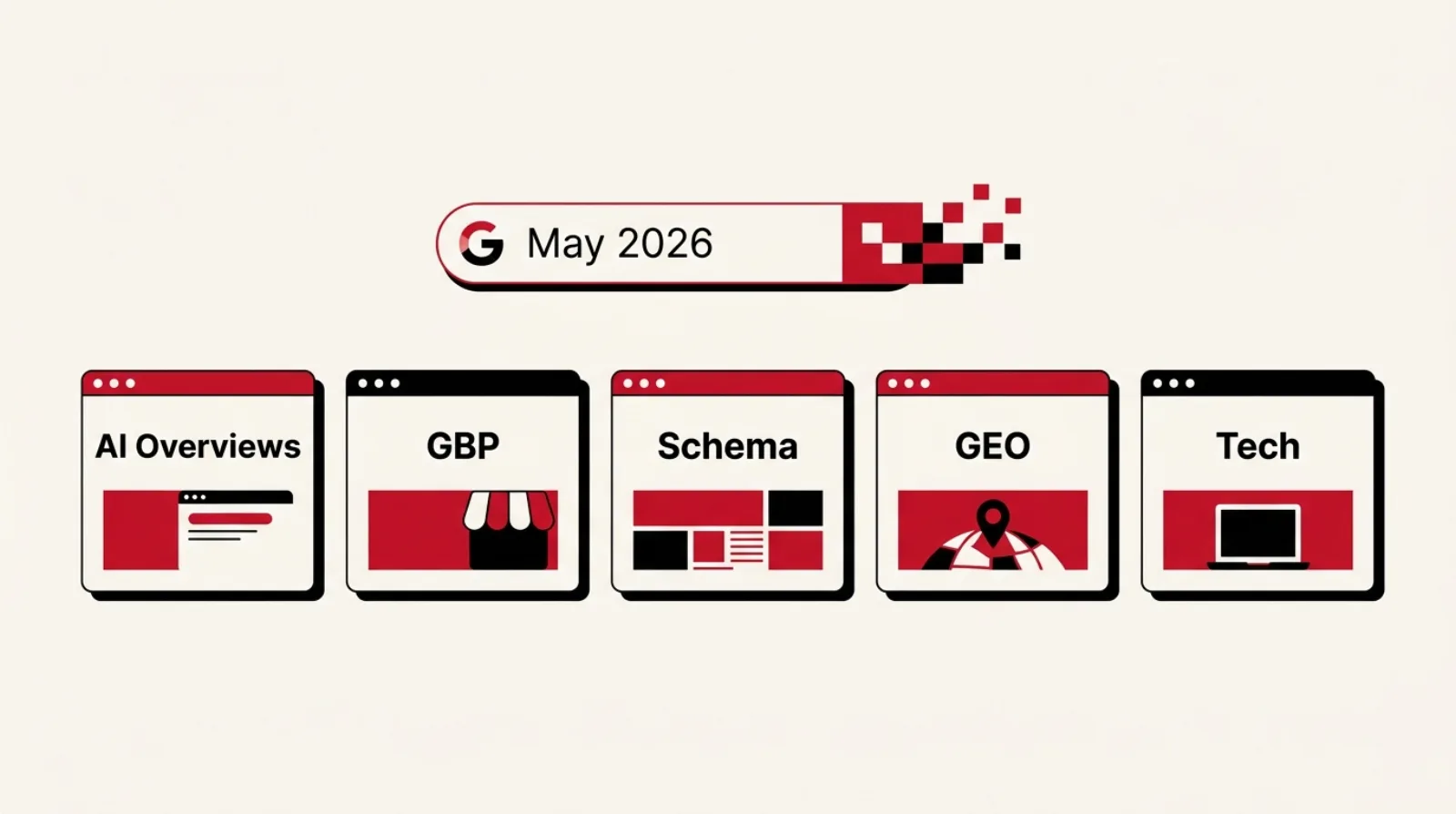
58% position-1 CTR drops define the 2026 search landscape per Ahrefs data covering 300K keywords. Google published its first AI Search Optimization guide May 15, 2026, followed by the May 21 core update. AI Mode reached 1 billion MAU at I/O 2026. Princeton GEO research shows Cite Sources boost position-5 pages by 115%.
Five days. That is the gap between Google publishing its first-ever AI Search Optimization guide and rolling out the May 2026 core update. In between, AI Mode crossed one billion monthly users. The playbook agencies and operators have used since the 2015 mobile update does not survive this week. The rules of visibility rewrote themselves in a single news cycle.
Google's May 2026 core update, announced May 21 via the Search Status Dashboard, is a "regular update designed to better surface relevant, satisfying content." The rollout takes up to two weeks. But calling it regular undersells what happened. Five days earlier, on May 15, Google published the AI Search Optimization guide on developers.google.com. At I/O 2026 on May 20, they announced AI Mode crossed 1 billion monthly active users, Gemini 3.5 Flash now powers it, and "always-on information agents" are rolling out. This is the single biggest week for SEO since the mobile update of 2015.
This post walks through five structural shifts that define the 2026 search reshuffle. First, AI Overviews and AI Mode have fundamentally changed what a click is worth. Second, Google Business Profile Q&A is dead and the replacement changes local SEO entirely. Third, schema markup and llms.txt files have been reframed by Google itself. Fourth, Princeton's GEO research now provides a concrete optimization method for generative engines. Fifth, the technical floor for indexing rose sharply. If you run a website that depends on Google for revenue, the next 3,000 words are the only thing on your reading list this week.
- AI Overviews cut position-1 organic CTR by 58%, and AI Mode is at 1 billion monthly users.
- Google retired GBP Q&A. Ask Maps now generates answers from your profile, website, and reviews.
- Google says llms.txt and schema are not AI ranking levers, but each still has a job.
- Princeton's GEO framework gives a measured, ranked method for getting cited by generative engines.
- The technical floor rose. Snippet eligibility is now table-stakes for AI citation.
Shift 1: AI Overviews and AI Mode Ate the Click
Ahrefs analyzed a 300,000 keyword sample (150,000 with AI Overviews present, 150,000 without) using December 2025 search data and published the results on February 4, 2026. The finding: AI Overviews reduce organic CTR for position 1 by 58%. That is up sharply from the 34.5% reduction they measured in April 2025. The trend line is not subtle. Pew Research tracked 68,879 real user queries from 900 U.S. adults and found users clicked results 8% of the time when AI summaries appeared, versus 15% without them. That is a 47% relative reduction. Authoritas published data showing the top organic CTR drops by roughly 79% when an AI Overview is present, with desktop traffic down 56.1% and mobile down 48.2%. And 99.2% of keywords that trigger AI Overviews are informational. Transactional and navigational queries still send traffic, but the informational middle ground is being absorbed.
AI Mode makes this worse. At I/O 2026, Google confirmed Gemini 3.5 Flash powers the experience. It handles multimodal follow-up queries. It acts as an agent. The "intelligent search box" announcement means users can refine, compare, and act without ever leaving the AI Mode interface. One billion monthly active users is not a test. It is the new surface. As covered in our piece on zero-click search, 80%+ of searches already end without a click, and AI Mode accelerates that number.
Two organic games now exist. Game one: rank inside AI Overview citations. Cited brands see uplift, and the mechanics are different from blue-link SEO. Our AI Overviews implementation guide covers the specifics. Game two: fight for the diminished blue links underneath. That game still matters for transactional queries, but the margin for error is smaller. You optimize for one or both. There is no third option.
The strategic implication for any operator: stop measuring SEO success purely in organic clicks. Track impressions, AI citation appearances, branded search volume, and direct traffic. The funnel still works. The first click is just no longer where it starts.
Shift 2: GBP Q&A Is Dead, Long Live Updates
Google retired the GBP Q&A API on November 3, 2025. The public-facing Q&A section on Business Profiles began phasing out on December 3, 2025. The replacement is an AI-powered feature called Ask Maps. It uses Gemini to generate answers in real time from the Business Profile, website, reviews, and posts. The old tactic of posting your own questions and answering them to seed keywords is dead. The API cannot create or sync questions anymore.
Google deprecated Q&A through the Business Profile APIs change log. Yext, Birdeye, and multiple local SEO outlets confirmed the end-of-life timeline through October to December 2025. This was not a quiet sunset. It was a deliberate removal of a feature that had been abused for years.
Three things change immediately for any local business operator. First, GBP Updates, formerly called Posts, are now the primary proactive lever. They decay after 7 days on the public profile. A weekly cadence is the minimum. Second, reactive Q&A still appears on a small number of legacy profiles. Owner responses get a "From owner" badge, and Google indexes them differently than before. Third, website-side FAQ pages with FAQPage schema become more important because Ask Maps pulls answers from them directly. Your FAQ page is now a piece of GBP infrastructure, not just a website page.
The practical stack is straightforward. Include the GBP API in your local SEO tooling. Use Python or any OAuth-enabled HTTP client. Google's documentation lives at developers.google.com/my-business. Post Updates weekly without gaps. Maintain a real FAQ page on the website with FAQPage JSON-LD. Keep reviews fresh because Ask Maps weights them heavily in its answer generation. Do not try to keyword-seed Q&A through third-party tools. The API cannot create or sync questions, and any tool claiming otherwise is selling vapor.
Shift 3: Schema and llms.txt Do Two Different Jobs
On May 15, 2026, Google published its AI Search Optimization guide and addressed the llms.txt question directly: "You don't need to create new machine readable files, AI text files, markup, or Markdown to appear in generative AI search." That sentence killed a lot of speculation in one stroke. Operators who spent Q1 2026 building elaborate llms.txt files expecting a Google ranking boost got their answer. It is not a lever for Google's AI surfaces.
But that does not mean llms.txt is worthless. The distinction matters. For Google AI Overviews and AI Mode, llms.txt does nothing. Google's crawlers do not read it as a ranking signal, and the guide makes that explicit. For non-Google AI crawlers, the story is different. Perplexity, ChatGPT, Claude, and Bing Copilot all consume llms.txt files when they are present. A properly structured llms.txt with a title block, description, link sections, and AI Citation Guidance gives those engines a clean machine-readable summary of what your business does and how to cite it. Think of it as hygiene for the non-Google half of the generative search ecosystem.
Schema.org markup sits in a similar bucket. Google's guide states: "Structured data isn't required for generative AI search, and there's no special schema.org markup you need to add. However, it's a good idea to continue using it as part of your overall SEO strategy." Translation: schema helps with rich results eligibility on traditional Search. It does not unlock AI Overview placement. But rich results still drive CTR on the blue-link SERP, and that SERP is not dead. It is just smaller.
The operator takeaway is clean. Schema is for rich results and traditional ranking signals. llms.txt is for non-Google LLM citation hygiene. Neither is a magic AI button. Stop treating either as one. For the broader context on how generative engine optimization differs from classical SEO, the GEO playbook lays out the full framework.
For schema, the minimum viable BlogPosting JSON-LD looks like this:
{
  "@context": "https://schema.org",
  "@type": "BlogPosting",
  "headline": "Your Article Title",
  "datePublished": "2026-05-26",
  "author": {
    "@type": "Person",
    "name": "Author Name"
  },
  "mainEntityOfPage": {
    "@type": "WebPage",
    "@id": "https://example.com/article-url"
  }
}
That covers the required fields. Add it to every page that does not have it. It will not make Google's AI cite you, but it keeps your rich result eligibility intact while the SERP reshuffles around you.
Shift 4: Princeton's GEO Methods Replace Keyword Optimization
In 2024, a research team from Princeton, Georgia Tech, the Allen Institute for AI, and IIT Delhi dropped a paper that turned out to be the playbook for the 2026 search landscape. "GEO: Generative Engine Optimization" by Aggarwal, Murahari, Rajpurohit, Kalyan, Narasimhan, and Deshpande was published at ACM SIGKDD 2024 and posted to arxiv.org/abs/2311.09735. The team tested nine optimization strategies across 10,000 queries on multiple generative engines. Their findings are now the closest thing operators have to a ranked list of what actually moves visibility in AI search.
The numbers are specific and worth memorizing. On the Position-Adjusted Word Count metric, Quotation Addition produced a 42.6% lift (PAWC 27.8 vs baseline 19.5), making it the single most effective method tested. Statistics Addition came in at +32.8%, Fluency Optimization at +28.7%, and Cite Sources at +27.7%. The headline finding of "up to 40% visibility boost" reflects the collective gain from layering the top techniques. The democratization story is in Table 2: for pages that started at SERP position 5, Cite Sources alone produced a 115.1% visibility increase, Quotation Addition 99.7%, and Statistics Addition 97.9%, giving lower-ranked sites a disproportionate lift. Meanwhile, Keyword Stuffing scored negative at minus 8.7%. The best combined results came from layering Cite Sources, Statistics Addition, Quotation Addition, and Fluency Optimization.
For an operator running client sites, this translates into a concrete rewrite checklist. Add one cited statistic from a named source in each H2 section of your top-converting pages. Quote one named expert per page with full attribution. Cite at least two to three external authoritative sources per long-form post. Use an Authoritative Tone: confident, declarative sentences with named entities, not hedge-words like "might" or "could potentially." And do not stuff keywords. The Princeton paper showed it does not help generative visibility, and it still carries risk in classical SEO.
These methods work across ChatGPT, Perplexity, Gemini, Copilot, and Claude. The underlying selection mechanism is similar across engines. They favor passages with embedded evidence from high-credibility sources. A page that cites a Pew Research stat, quotes a named industry figure, and links to an Ahrefs study is simply more citable than a page that makes unsupported claims. The content optimizations that win on Princeton's GEO-bench translate because the engines are all solving the same problem: which text block is most trustworthy to surface as an answer. For the full implementation steps on getting cited in Google's AI features specifically, see our AI Overviews implementation guide.
Shift 5: The Technical Floor Raised
Google's AI optimization guide states the requirement plainly: "a page must be indexed and eligible to be shown in Google Search with a snippet, fulfilling the Search technical requirements" to be eligible for AI features. Snippet eligibility is now table-stakes for AI citation. If your page cannot show a standard search snippet, it cannot appear in AI Overviews or AI Mode. The technical floor moved upward in May 2026, and a lot of sites did not notice.
Five specific changes matter in practice. First, LCP via critical CSS inline. On one client site, the home page LCP dropped from 7216ms to 1956ms, and the Performance score jumped from 74 to 98, by switching Astro to build.inlineStylesheets: 'always' and reordering the hero image preload to just after the viewport meta tag. The cost was 14KB gzipped per page. Second, mobile image srcset optimization. Another client site cut Lynchburg location-page LCP from 3485ms to 3151ms by serving 1024w WebP variants instead of 1600w originals. On a Moto G4 emulator with a 412 viewport at DPR 2, the effective pixel width is 824, so the browser picks the 1024w variant over the 800w. That is the variant to optimize.
Third, the Indexing API now works batch-style with OAuth, no service-account key required, for sitemap-style submissions. A daily batch cron at 02:00 UTC pushing 100 to 200 URLs per site is realistic. Through May 2026, our measurements showed re-index latency dropping by 4 to 6 days. Fourth, IndexNow for Bing is free and simple: an HTTP POST to api.indexnow.org. Bing and Copilot crawlers pick it up within hours. There is no reason not to add it. Fifth, run a snippet eligibility audit. Grep your codebase for nosnippet, max-snippet:0, or noindex and make sure none of those directives are on revenue pages. If a page cannot show a snippet, it cannot be cited in AI Overviews.
The technical floor used to be "page loads under 3 seconds." It is now "passes Core Web Vitals, snippet-eligible, server-indexable, and submitted to Indexing API plus IndexNow." That is a higher bar, but the tools to meet it are free and the implementation is straightforward.
What Operators Must Do This Quarter
The May 2026 reshuffle is not theoretical. It is measurable in GSC right now. Here is the checklist operators should run this quarter.
- Audit AI-Overview-driven traffic loss in GSC. Filter "search appearance" for AI features and compare the last 90 days of CTR. Identify which pages lost clicks to AI Overviews and by how much.
- Switch GBP cadence from Q&A seeding, which is gone, to weekly Updates. Maintain a real FAQ page on the website with FAQPage schema so Ask Maps has structured content to ingest.
- Add BlogPosting and LocalBusiness schema to every page that does not have it. Treat it as rich-results hygiene, not AI magic.
- Deploy llms.txt with title, description, link sections, and AI Citation Guidance. Do not expect it to move Google rankings. Do expect it to help Perplexity, ChatGPT, and Claude understand your business.
- Rewrite your top 10 commercial pages with the Princeton method. One cited statistic per H2, one expert quote per page, three or more authoritative external links, no keyword stuffing.
- Inline critical CSS. Audit LCP. Cut hero images to 1024w mobile srcset variants.
- Wire the Indexing API on OAuth and IndexNow. Set a daily cron.
- Grep for
nosnippetandmax-snippet:0. Remove from anything you want surfaced in AI features.
If any of this feels like more than your team can ship in a week, book a free SEO and GBP audit and we will triage it with you.
The Bottom Line
The week of May 15 to May 21, 2026 is the single biggest structural shift in search since mobile-first indexing rolled out in 2018. AI Mode at one billion users is not a future milestone. It is the current reality. Google's AI optimization guide tells operators directly that there is no special markup, no llms.txt magic, no schema trick. The levers are unchanged in spirit. Good content, technical hygiene, structured data for rich results, GBP discipline. But the surface area shifted. AI Overviews ate 58% of clicks on position one. GBP Q&A is gone. The GEO citation game has measured methods that work, and the Princeton paper gave us the ranked list.
Pick the two or three items from the checklist above that fit your biggest revenue page. Ship them this week. Then measure GSC and GA4 over the next 30 days. The operators who adapt in May 2026 will own the surfaces. The ones who wait six months will be writing fresh-from-scratch content for a half-empty SERP.
If you want help running this audit on your site, that is exactly what MySEODesk does. Get in touch.
- AI Overviews and AI Mode reshape what a click is worth. Track impressions, citations, and direct traffic, not just clicks.
- GBP Q&A is retired. Weekly Updates plus on-site FAQPage schema feed Ask Maps.
- Google's AI guide reframed llms.txt and schema. Both still matter, just not as Google AI ranking levers.
- Princeton's GEO methods give a measured, ranked path to citation in generative engines.
- The technical floor is now Core Web Vitals plus snippet eligibility plus Indexing API plus IndexNow.
