Farm Automation: How IoT Protects Cattle Ranches and Plantain Farms in Colombia
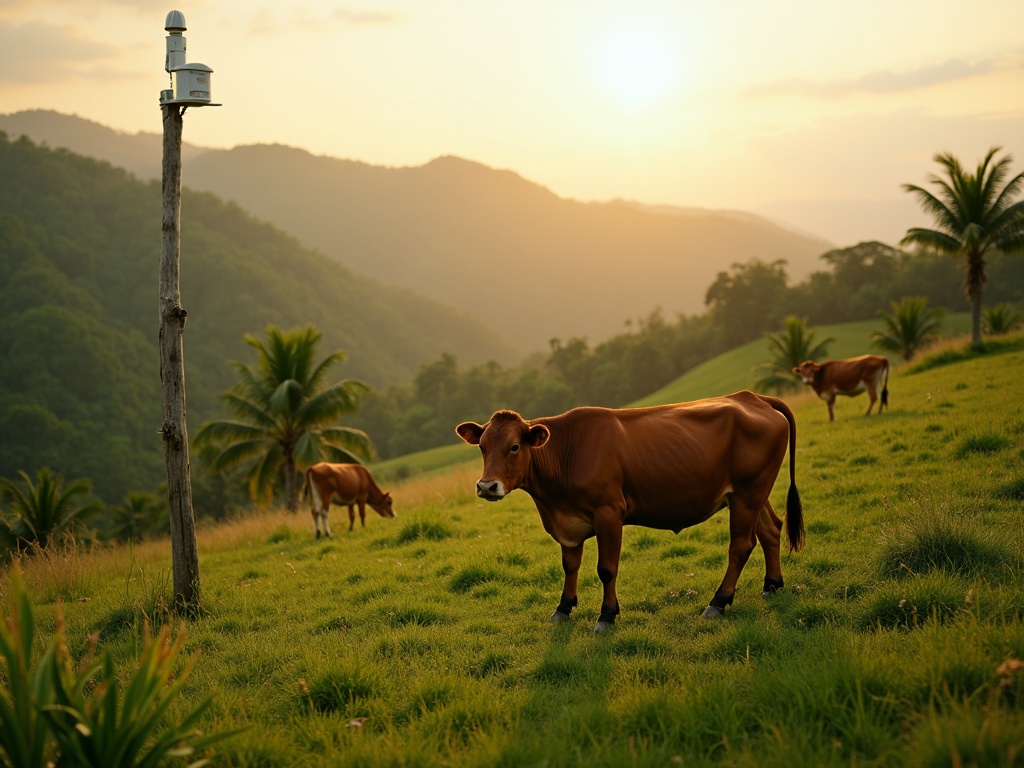
I built a Colombian farm system tracking two hundred plus cattle by RFID and auto-weighing monthly at the trough. It covers twelve hectares plantain with soil sensors triggering irrigation, harvest by lot, sales by weight. FastAPI, MariaDB on Synology NAS, Raspberry Pi over MQTT, and Astro dashboard run it for under two thousand dollars with no SaaS or per-cow fees.
In the Eje Cafetero and across Colombia's tropical lowlands, cattle ranchers and plantain farmers face the same enemy every afternoon: rain. It comes fast, often without warning. It destroys things that took days or weeks to prepare. Hay bales left uncovered soak up water and rot within 48 hours. Plantains spread out to dry get wet again. Fungal colonies grow on them, making them unsellable. Feed troughs fill with rainwater, diluting nutritional supplements and creating breeding grounds for parasites.
The traditional solution is manual labor. Someone watches the sky. Someone runs out to pull a tarp over the feed storage. Someone closes the drying shed doors. But on a working ranch, hands are already stretched thin managing livestock, fencing, milking, and transport. Nobody is standing by waiting for rain. The covers stay open. The feed gets ruined. The crop loss compounds season after season.
IoT automation solves this the same way it solves the problem for urban terraces and pergolas. It removes the human from the reaction loop. But on a farm, the stakes are higher. This isn't about protecting patio furniture. It's about protecting the economic output of the operation.
The Problem: Rain Damage to Feed and Crops
Colombia is the world's fourth-largest plantain producer. Plantains are one of the most perishable crops in tropical agriculture. With moisture content exceeding 60%, freshly harvested plantains are extremely vulnerable to fungal infection during the post-harvest drying and curing process. A single unexpected rain event during drying can trigger Colletotrichum and Fusarium growth. This renders an entire batch unmarketable. In the Eje Cafetero departments of Caldas, Risaralda, and Quindio, many cattle ranches also cultivate plantain and banana as secondary crops. This dual exposure to rain damage compounds the financial risk.
On the cattle side, rain damage to stored feed is a persistent drain on profitability. Wet hay develops mold that produces mycotoxins. These compounds cause digestive problems, reduced milk production, and in severe cases, liver damage in cattle. A rancher who loses 20% of stored feed to rain damage every season is effectively paying 20% more for feed than necessary. In a country where cattle operations already contend with high transport costs and limited cold chain infrastructure, that margin erosion is the difference between a viable operation and one that slowly bleeds money.
Cattle Ranch Automation: Protecting Feed and Livestock
The most immediate application of IoT automation on a cattle ranch is automated cover systems over feed storage areas. The concept is identical to a residential retractable roof, but scaled for agricultural use. A motorized cover sits over the hay storage area, feed troughs, or silage bunkers. It can be a retractable tarp system or a hinged panel roof. An IoT controller with a rain sensor monitors conditions and closes the cover automatically when moisture is detected.
Feed storage protection. Open-air hay storage is common on Colombian ranches where barn construction is cost-prohibitive. An automated retractable cover over the hay stack provides the protection of a barn at a fraction of the cost. The cover opens during dry conditions to allow airflow, preventing internal moisture buildup. It closes within seconds when the rain sensor activates. Over a typical rainy season in the Eje Cafetero, where rain falls 200+ days per year, this prevents dozens of wetting events that would otherwise degrade feed quality.
Milking station shelters. Open-sided milking shelters benefit from automated rain curtains or side panels. These deploy when wind-driven rain threatens to soak the milking area. Wet conditions during milking increase the risk of mastitis in dairy cattle. This bacterial infection reduces milk yield and requires antibiotic treatment. Keeping the milking area dry is both an animal welfare measure and an economic one.
Environmental monitoring. Beyond rain protection, IoT sensors can monitor temperature, humidity, and ammonia levels in livestock areas. Heat stress reduces feed intake and milk production in cattle. An IoT system can trigger ventilation fans, misting systems, or shade covers based on temperature thresholds. It maintains optimal conditions without constant human oversight. GPS and RFID tracking for individual animals is already established technology. Integrating shelter automation with livestock tracking creates a unified farm management platform.
Feed Protection
Automated covers over hay and silage storage. Rain sensor triggers closure in seconds. Prevents mold, mycotoxins, and 20%+ annual feed loss.
Milking Shelters
Rain curtains deploy automatically on open-sided shelters. Reduces mastitis risk and keeps milking areas dry during tropical storms.
Climate Monitoring
Temperature, humidity, and air quality sensors. Triggers ventilation and cooling systems to reduce heat stress in livestock.
Plantain Post-Harvest Protection
Post-harvest handling is where the most value is lost in plantain farming. The drying and curing process needs controlled air and sunlight. These conditions are best during clear weather but terrible during rain. Traditional drying sheds in Colombia have fixed roofs with open sides. They protect against direct rainfall. But they do not stop wind-driven rain or the humidity spikes that follow tropical storms.
An IoT-automated drying shed uses covers or louvers that move. They respond to the environment in real time. During sunny, low-humidity periods, the covers open fully. This allows maximum airflow and solar drying. When the rain sensor detects moisture, the covers close. They also close if humidity goes above a set limit, typically 80-85% relative humidity. This prevents the fruit from getting wet again. A fixed-roof structure cannot provide this dynamic response.
Humidity-based automation is very valuable for plantain drying. The damage does not require direct rain contact. A long period of humidity above 85% creates conditions for fungal growth on partly dried fruit. An automated system closes the shed and turns on dehumidification fans when humidity passes the limit. It does this without anyone checking a hygrometer. The system also logs all environmental data. This record helps farmers improve drying schedules and spot troublesome weather patterns over time.
Solar drying optimization. The system tracks solar intensity, humidity, and temperature. It can then calculate the best drying windows. It alerts farmers when conditions are ideal for spreading new batches. This data-driven method reduces drying time. It improves product quality. It also lowers the labor needed for constant manual monitoring.
Combined Farm IoT: One System for Cattle and Crops
The real efficiency gain comes from a single IoT platform. It manages both livestock and crop protection on a mixed-use farm. In the Eje Cafetero, a single property often runs cattle and grows plantain, banana, or coffee as secondary crops. A unified SyncSita-style automation platform can control multiple zones from one dashboard. It manages feed storage covers, milking shelter curtains, drying shed louvers, and environmental sensors. All of them report to a single interface.
This consolidation matters because rural farm workers should not need to manage multiple apps or systems. There is one dashboard, one set of alerts, and one login. The platform handles the logic. If rain is detected at Zone 1 (feed storage), it closes the cover. If humidity exceeds 82% at Zone 3 (drying shed), it closes the louvers and starts the fans. If the temperature at Zone 2 (milking shelter) exceeds 32°C, it activates the misting system. Each zone works independently with its own sensors. But the farmer sees everything in one place.
WhatsApp notifications are very effective in the Colombian context. WhatsApp is the main communication platform, even in rural areas. A message like "Zona forraje: cubierta cerrada, lluvia detectada" gives the rancher immediate confirmation. They do not need to open an app or check a dashboard. Critical alerts, sensor offline, motor fault, extended humidity exceedance, can be escalated to phone calls for urgent attention.
Connectivity: Starlink Changes the Equation
The big problem for rural IoT in Colombia has always been connectivity. According to DANE data, only 28.8% of rural Colombian households have internet access. Traditional ISPs do not extend fiber or even DSL to remote fincas. Cellular coverage exists in many areas but is unreliable. Signal quality varies dramatically with terrain and weather.
Starlink's availability in Colombia, which began in 2023 and has expanded steadily, fundamentally changes the viability of cloud-connected farm automation. A Starlink terminal provides 50-200 Mbps download speeds with latency under 40ms. This is more than enough for IoT telemetry, dashboard access, and weather API polling. The hardware cost is approximately $599 USD for the kit. The monthly service fee is $45-65 USD. These costs are significant but reasonable for a commercial farming operation. The operation stands to save multiples of that amount in prevented crop and feed losses.
Critically, a well-designed IoT system does not depend on connectivity for its core protection functions. The rain sensor and motor controller operate locally on the ESP32 microcontroller. If Starlink goes down, if the router reboots, or if the cloud platform is unreachable, the covers still close when it rains. Connectivity adds the intelligence layer. This includes weather prediction, remote monitoring, historical data, and multi-zone coordination. But the physical protection works without it. This local-first architecture is essential for agricultural deployments. There, connectivity interruptions are expected, not exceptional.
Implementation: Getting Started
For a Colombian cattle ranch or plantain farm considering IoT automation, the implementation follows a practical sequence:
Start with the highest-value protection point. For most operations, this is either the primary feed storage area or the plantain drying shed. Choose whichever represents the largest annual loss from rain damage. Install a single automated cover with a rain sensor and IoT controller. Prove the value on one zone before expanding.
Choose motorized cover hardware that fits the structure. Retractable tarp systems work well for open feed storage areas. Hinged panel roofs suit drying sheds. Roller curtains protect open-sided shelters. The IoT controller connects to any motorized system via relay output. This is the same interface used for residential automation systems.
Establish connectivity. If cellular coverage is adequate (3G minimum for IoT telemetry), a simple SIM-based gateway works. For remote locations without reliable cellular, Starlink provides the backhaul. In either case, the local rain sensor provides protection independent of connectivity.
Add environmental sensors incrementally. Once the cover automation is proven, add temperature and humidity sensors. This builds out the monitoring layer. These sensors are inexpensive (under $15 each for industrial-grade DHT22 or BME280 modules). They connect to the same ESP32 controller that runs the cover automation.
Scale to additional zones. Each new zone gets its own controller and sensors. All of them report to the same cloud dashboard. The incremental cost per zone drops because the connectivity infrastructure (Starlink or cellular gateway) is already in place.
Colombian cattle ranches and plantain farms lose significant revenue every rainy season to preventable water damage. Automated retractable covers with IoT rain sensors protect feed storage, drying sheds, and livestock shelters. They do this without requiring someone to watch the sky. The technology is the same proven system used for residential terraces and commercial pergolas, adapted for agricultural scale. Starlink solves the rural connectivity gap. Local-first sensor operation ensures protection even offline. There is no longer a technical barrier to farm automation in the Eje Cafetero and beyond. The question is not whether the technology works. It is how many seasons of crop and feed loss a farm can afford before implementing it.
